
Mineral Water: Anticipating Pesticides, Metabolites & PFAS
TFA, secondary metabolites, banned actives: how mineral water bottlers trace detections, target their analyses and protect the catchment area.

A laboratory reports a quantified result. Not a well-known active substance: a secondary metabolite no one on the team had ever heard of, or TFA. Within hours, three questions land at once — where does it come from, is it rising, and what do we tell the health authorities and our customers? And a fourth, quieter one: are we going to have to shut down the borehole?
More and more mineral water producers are living through this sequence. It has one thing in common: it always plays out too late. Not because teams react badly, but because the diagnosis begins at the moment of analysis, whereas the contamination itself began five, ten or twenty years ago on the catchment area.
A natural mineral water is defined by its original purity: permitted treatments are strictly regulated. Where a network operator can install an activated carbon stage, you have only one option — that the molecule never arrives at all. The risk does not translate into extra treatment costs, but into a shut-down catchment, lost volumes and damage to the brand.
Priority 1: knowing what is heading for the catchment before the analysis
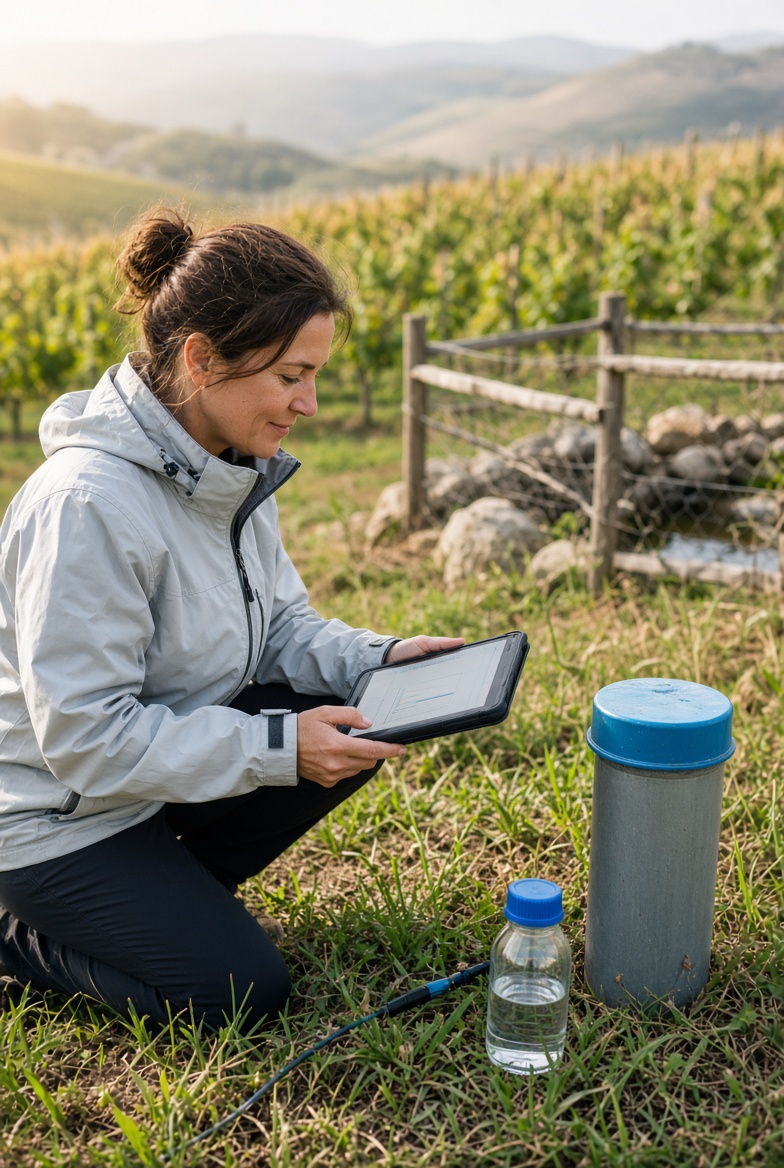
A conventional monitoring plan looks for what it has been asked to look for. It therefore structurally misses two categories: secondary metabolites, often more soluble and more mobile than their parent molecule, and fluorinated substances that generate TFA. The result: the first detection is almost always a surprise.
We tackle the problem from the other end. Starting from the plant protection practices on your recharge area — current and past, including banned molecules still lingering in soils and the unsaturated zone — we estimate which substances, which metabolites and which PFAS have a significant probability of reaching your resource, and on what time horizon.
This is not a theoretical exercise: it is what allows you to target your sampling on the right parameters, at the right points, at the right times. The analysis budget does not increase. It is reallocated — and the results become interpretable, because they answer a hypothesis.
Priority 2: a molecule has been quantified, and the response must be evidence-based
When a detection comes in, the company needs one thing: a defensible explanation, fast. Yet a metabolite may originate from several active substances, some withdrawn from the market years ago — and the parent molecule is frequently undetectable by the time its degradation product appears.
We reconstruct that chain of causality in reverse: from the quantified metabolite back to the probable parent molecules, weighted by the likelihood of use across your territory; then to the crops concerned, cross-referenced with the actual cropping pattern of the catchment area; then to the zones and application periods that contribute most, modulated by local vulnerability (soil, slope, thickness of the unsaturated zone, karst, drainage).
The deliverable is not legal proof. It is better, for what you actually need to do: a ranking of probable contributions, on which to build a coherent narrative for the authorities, a technical dialogue with the farmers concerned, and a sampling plan to confirm.
The case of TFA deserves a word. It is often brushed aside with "it's not agricultural, there's nothing we can do": its origins are multiple (fluorinated active substances, fluorinated gases, industry). That is premature. On a given catchment area, the share attributable to plant protection uses can be estimated from the cropping pattern, the fluorinated substances authorised on those crops and molar conversion rates. That share varies enormously from one site to another — and that is precisely what makes the estimate decisive: it tells you whether or not there is an agronomic lever to pull.
Priority 3: acting without antagonising farmers — and being able to prove it
The blacklist is the instinctive answer. Too long, it becomes unworkable and discredits the whole approach in the eyes of farmers; too short, it lets the essentials slip through.
Our indicators combine two dimensions that are often confused: the intrinsic hazard of the substance and its transformation products, and the risk of occurrence in your resource, which depends on mobility, persistence and the vulnerability of the application zone. A substance of concern but strongly adsorbed onto a deep clay soil does not call for the same action as a moderately problematic molecule applied over outcropping karst.
You then know where to start: which substances, which fields, which farmers. And alternatives are assessed crop by crop — efficacy on the target, positioning within the programme, resistance risk, feasibility — with one criterion that has become unavoidable: the transfer potential of the alternative's metabolites, and whether or not it is fluorinated.
Le nombre de substances actives fluorées homologuées progresse depuis deux décennies. Une substitution qui ne regarde que le profil écotoxicologique classique peut, en toute bonne foi, remplacer un problème par un générateur de TFA.
Finally, tracking your scores over time documents the effort. It is a leading indicator: it moves when practices move, without waiting for the change to show up in the aquifer. Usable internally to allocate support resources, with farmers to give credit for the efforts made, and externally — CSRD reporting, regulatory exchanges, retailers.
What this looks like in practice
The first step requires no additional analyses. It relies on the history of cropping patterns and plant protection uses across your recharge area, cross-referenced with vulnerability zoning and your existing analytical results.
At the end of this first pass, you have three things: a ranked list of the molecules and metabolites to monitor as a priority on your site, an estimate of the probable origins of the parameters already quantified, and an action plan ordered by expected benefit for the resource. The loop then closes: targeted analyses are compared with the predictions, adjustments are made, and knowledge of your catchment area sharpens vintage after vintage.
Time is not on your side
An aquifer never makes up for lost time. Every farming season that goes by without a diagnosis is one more year that will flow, in five or fifteen years' time, into a borehole you will still be operating.
If a molecule has just been quantified at your site, or if you want to know what your analyses are not yet looking for, get in touch: we will review your catchment area, your latest results and your points of concern together. Ten years of work on pesticide toxicity and transfer modelling, from field to water and from water back to field — this is exactly the subject.
Discover the landing page
Anticipate pesticides, their metabolites and PFAS before they reach your resource →